
Guest Critic
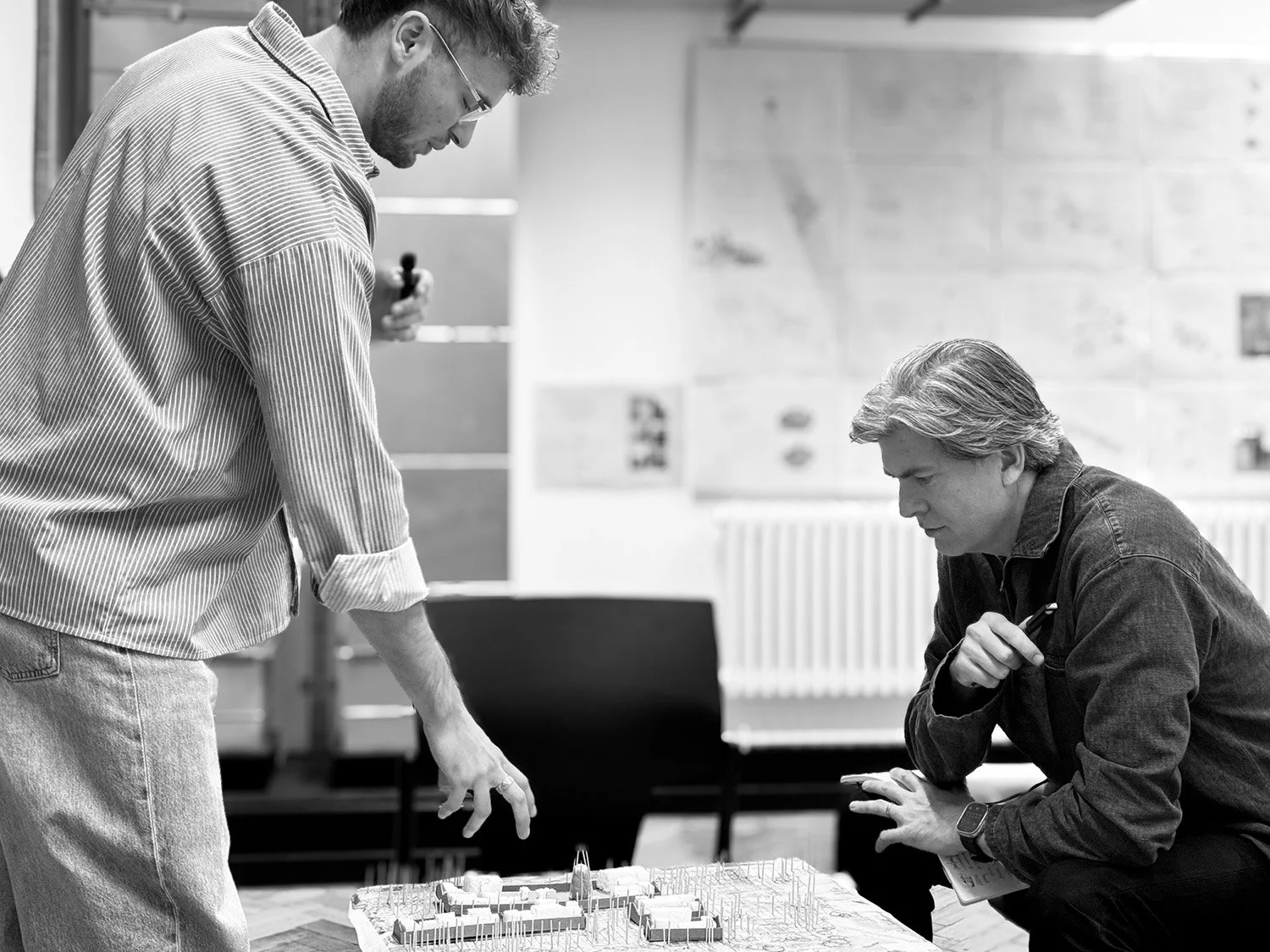
For me, end of year reviews are where the work feels most honest. The student is still close to the original question, and close enough to remember why it mattered. That is why I keep going back. At this level, the final review is not just about judging finished work. It is a conversation about how each student is beginning to shape their own architectural voice, and how each of us might help move architecture forward, even in a small way.
Yesterday it was the Welsh School of Architecture. Kay, my partner, reminded me I have taught there for more than twenty years as a unit leader, reviewer and moderator. This time, invited as final reviewer for Shibu Raman. The cohort had spent the year on Somnath, the temple town on the Gujarat coast of India, asking what it would take to make it a more liveable city. The question matters. Somnath absorbs an extraordinary flow of pilgrims against a shifting coastline, and the sacred ground sits in close, sometimes uncomfortable, conversation with the everyday life of those who live there. I think the danger is that one will erase the other. Liveability, for Somnath, is the question of whether the town can hold both.
Our own work at Hyde+Hyde sits in the exchange between these two scales. The large-scale grain of cities has always fascinated me, following my initial encounter with The Architecture of the City by Aldo Rossi. It is a book that opened my eyes to the beautiful, idiosyncratic human tendencies that make the city a truly living organism. And, of course, to the small, everyday life that takes place inside them as they resist entropy. Each feeds the other. Neither really makes sense alone. The cohort's year-long enquiry sat comfortably in exactly that exchange, and it was a beautiful place to spend a warm spring day.
Somnath is a difficult subject to take on at this scale. Steven Holl, writing on urbanism, called the right disposition for work like this working with doubt: cities resist rational diagrams, and must be read subjectively if their experiential power is to survive the planning. The work I respected most had taken that seriously. It had read the place deeply before projecting any bias onto it, a hard thing to do..
But the day's real subject was the moment that always comes for a student, and never stops coming for a practising architect. The all-too-familiar move from research into response. When the facts have been gathered, the constraints laid out, and the listening done, there is that fragile point that we almost miss consciously, it slides by us. When there is nothing further hiding behind enquiry. You just have to act… Yes and nowhere to hide. The strongest discussions of the day landed here, between the emotion and the act.
That act is the existential leveller. Whatever you have experienced on site, whatever you have read, whatever references you carry, whatever you have absorbed from peers, poetry, art, culture, statistics, or the AI tools that now promise to think for us, none of it acts on your behalf. You act, in front of the work. A student in their first crit and an architect long in practice meet at the same threshold. The crossing reveals a vulnerability and power at the same time, and it asks the same of everyone.
It is also where the power of architecture resides. Your freedom resides here. The transformation of a person's life through architecture is only possible when our response is honest about what the research revealed. Without that honesty, design becomes decoration on top of evidence. With it, architecture has the chance to change how someone lives, how communities can thrive.
An urban strategy can hold contradictions for a long time before they become visible. A single building cannot. Where the work was strongest, the catalyst sharpened the strategy. Where it was weakest, the building was being asked to carry an argument that hadn't yet earned its weight through its tectonic expression.
On reflection I came back to the studio with a thought….
The crossing from research to response does not get easier with experience. It only gets more honest. As Marcus Aurelius wrote, ‘what stands in the way becomes the way’. Reviewing well means seeing who already knows it, and I think remembering that the same threshold sits in front of us at every stage of our own work back here in the studio.
I think reviewing is also a way of being reviewed. You learn pretty quickly what you have stopped questioning and you are reminded why you began.
—